

Description
Buy HU-210 Online USA | HU-210 For Sale Online | Order HU-210 Research Chemical Online
DESCRIPTION
HU-210 in Recreational Use
HU-210 is a full agonist of the CB1R/CB2R and is used for the prevention and treatment of cardiac arrhythmias. It affects various aspects of the action potential, including the polarization-repolarization phase, excitability or refractoriness, impulse conduction, and membrane responsiveness in cardiac fibers.
HU-210 is a synthetic cannabinoid that is reportedly 100 times more potent than THC. It is often found in the so-called “herbal mixture” known as “Spice,” which is commonly smoked for its psychoactive effects under names such as Genie and Yukatan. According to research, 25-100 μg/kg of HU-210 should be equivalent to doses of THC ranging from 2.5-10 mg/kg.
In animal studies, HU-210 has an oral LD50 of 5,000mg/kg in rats and 14,200mg/kg in rabbits. In humans, the LDLO (Lowest Lethal Dose amount) of HU-210 has been reported to be 143mg/kg, which is significantly lower than the estimated LD50 of caffeine, which ranges from 150-200 milligrams per kilogram. However, the LD50 of Delta-8-THC has not been confirmed. In a 1973 study, monkeys and dogs were given doses of 9,000mg/kg of Delta-8-THC, which was found to be nonlethal.
HU-210 is a synthetic cannabinoid that was first synthesized in 1988. The synthetic process for HU-210 is outlined in Figure 4, with more specific details available in [14]. To begin, [1S,5R]-myrtenol is obtained through the oxidation of a-pinene. HU-210 can then be synthesized from [1R,5S]-myrtenol, while HU-211 can be synthesized from [1S,5R]-myrtenol. General sheme on Figure 4.
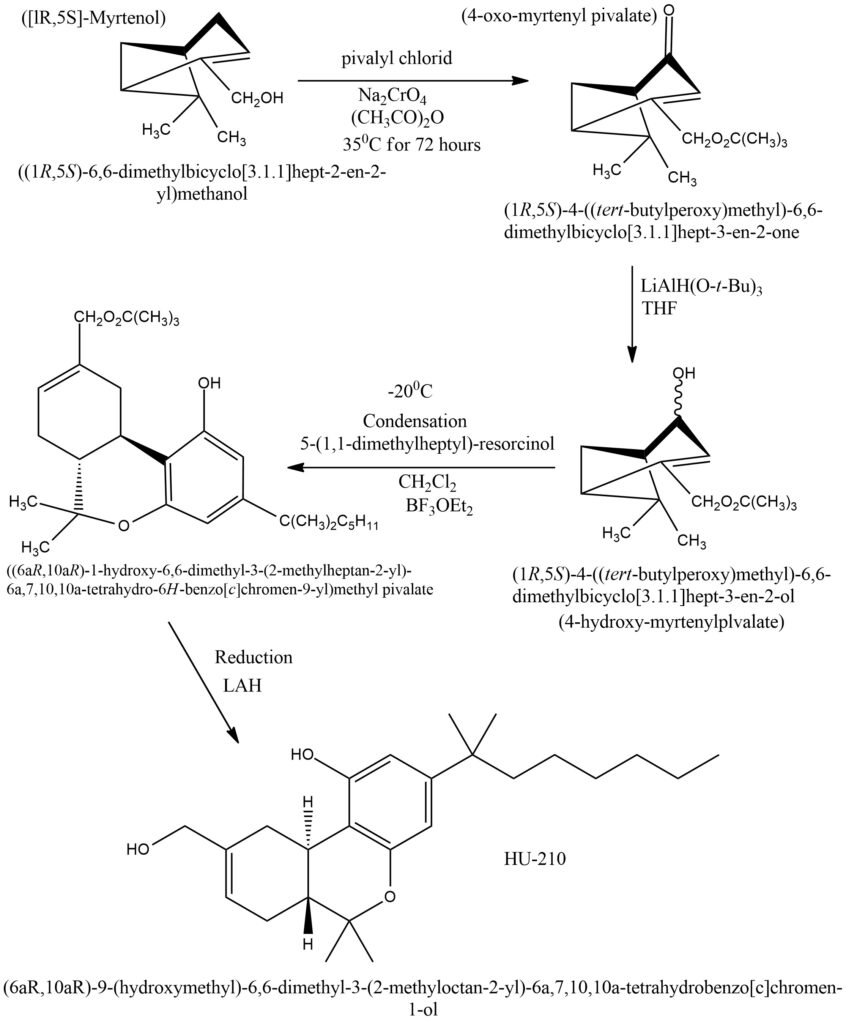
There are four main groups of anti-arrhythmia agents based on their mechanism of action, including sodium channel blockade, beta-adrenergic blockade, repolarization prolongation, or calcium channel blockade. HU-210 is also used to prevent nausea or vomiting.
Excitatory amino acid antagonists are drugs that bind to but do not activate excitatory amino acid receptors, blocking the actions of agonists.
HU-210 is a potent analgesic with effects similar to natural THC. It is also a neuroprotective agent, preventing damage to the brain or spinal cord from ischemia, stroke, convulsions, or trauma. Some neuroprotective agents must be administered before the event, while others may be effective for some time after.
They act by various mechanisms, often minimizing damage produced by endogenous excitatory amino acids.
Cannabinoids and their derivatives are of great interest due to their potential psychoactive effects for treating psychiatric disorders and symptoms.
However, their clinical application is limited by various side effects, including impaired coordination, anxiety, and learning and memory disability. The dorsal striatum-dependent learning is particularly affected by cannabinoids.
Reinforcement learning is one of the most important forms of learning mediated by the dorsal striatum, characterized by an initial association learning phase, followed by habit learning. While the effects of cannabinoids on habit learning have been extensively studied, little is known about how they influence the initial phase of reinforcement learning.
Research has shown that acute activation of the cannabinoid receptor type 1 (CB1R) by the synthetic cannabinoid HU210 impairs dose-dependent association learning, which can be alleviated by the intra-dorsomedial striatum (DMS) injection of a CB1R antagonist.
Furthermore, acute exposure to HU210 elicited enhanced synaptic transmission in striatonigral “direct” pathway medium spiny neurons (MSNs) but not in indirect pathway neurons in DMS. Interestingly, enhancement of synaptic transmission observed after learning was abolished by HU210, indicating that the cannabinoid system may disrupt reinforcement learning by confounding synaptic plasticity required for learning.
Notably, impaired response-reinforcer learning was also induced by selectively enhancing the activity of dopamine receptor type 1 (D1-MSN) through the virally expressed excitatory hM3Dq DREADD, which could be rescued by specifically silencing the D1-MSN activity via hM4Di DREADD.
Effects of Cannabinoid Use
HU-210, a potent analgesic, has been found to have similar effects as natural THC. Recent research indicates that acute administration of HU-210 can affect association learning and motor activities in a dose-dependent manner, as well as decrease body temperature.
To date, there have not been any studies published on the psychotropic effects of HU-210 in humans, despite its synthetic cannabinoid nature and discovery in 1988. HU-210 is reputedly 100 times more potent than THC, and is a powerful analgesic with effects comparable to those of natural THC.